

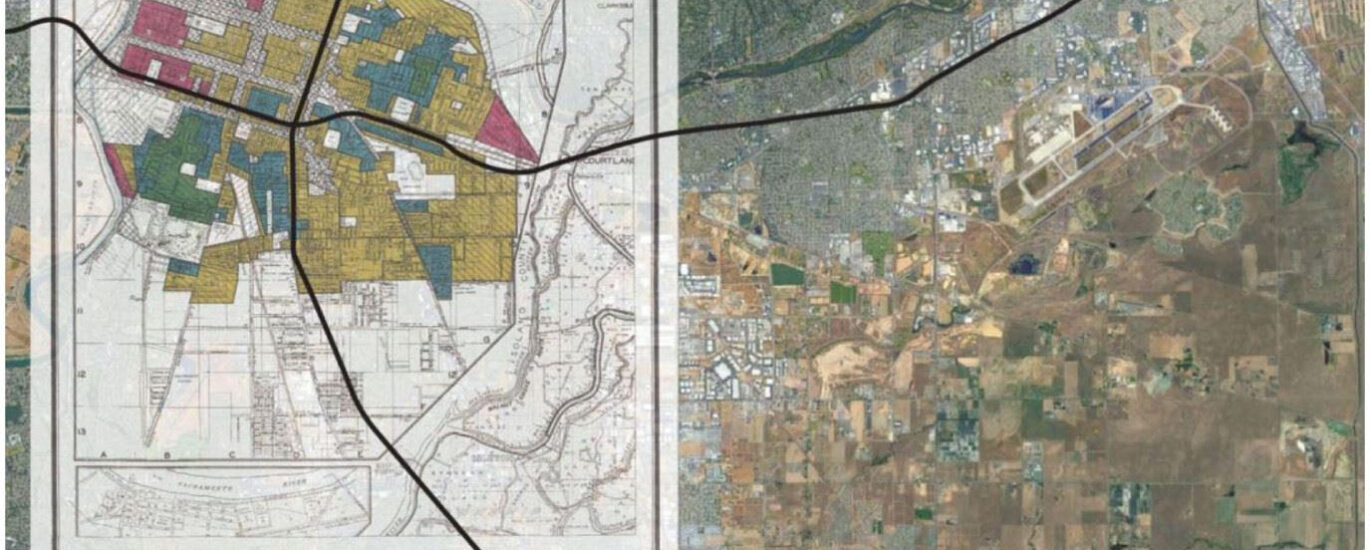
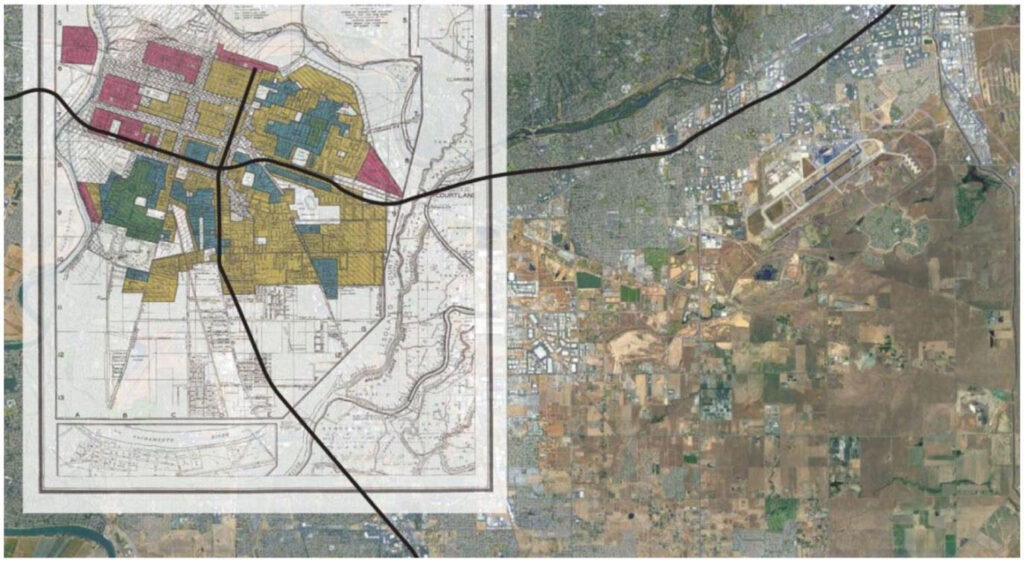
Source: Robert K. Nelson, LaDale Winling, Richard Marciano, Nathan Connolly, and Edward L. Ayers, “Mapping inequality: Redlining in new deal America,” American Panorama: An Atlas of United States History. University of Richmond: Digital Scholarship Lab 17 (2020): 19, https://dsl.richmond.edu/panorama/redlining/; Google, “Google Earth.”
In “The Historical Impacts of Freeway Construction and Urban Renewal in Sacramento,”Aakansha Jain, Juan Carlos Garcia Sanchez, Jesus M. Barajas, and Susan L. Handy examine how in California, as in other parts of the country, freeway construction fueled decentralization and suburbanization. Using archival research, census data, and interviews with community members this paper explores how freeway construction and urban renewal together reshaped Sacramento’s landscape. The construction of US-50 and SR-99 through the city created economic and social disparities in Oak Park, a predominantly African American neighborhood. Construction of I-5 on the west end of the city contributed to displacement of Japanese Americans and several other communities of color. The legacy of freeway building, combined with other policies, continues to disproportionately impact communities of color in Sacramento.