

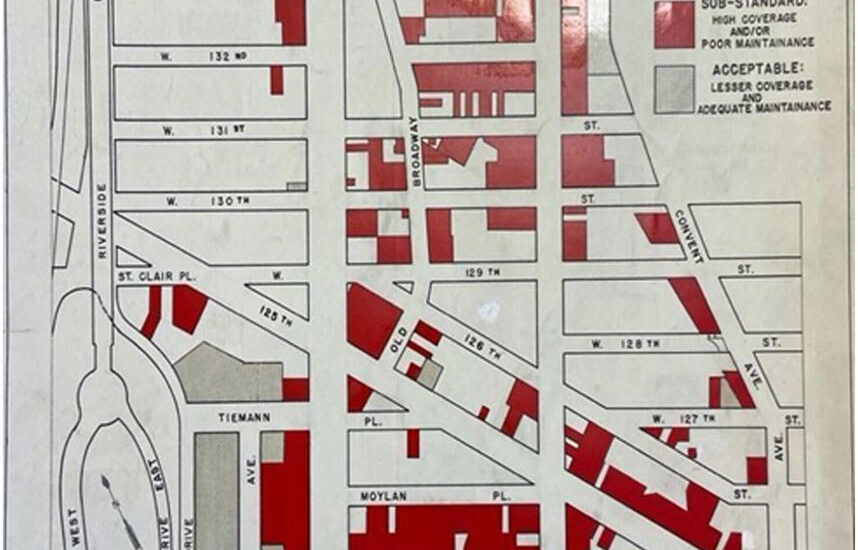
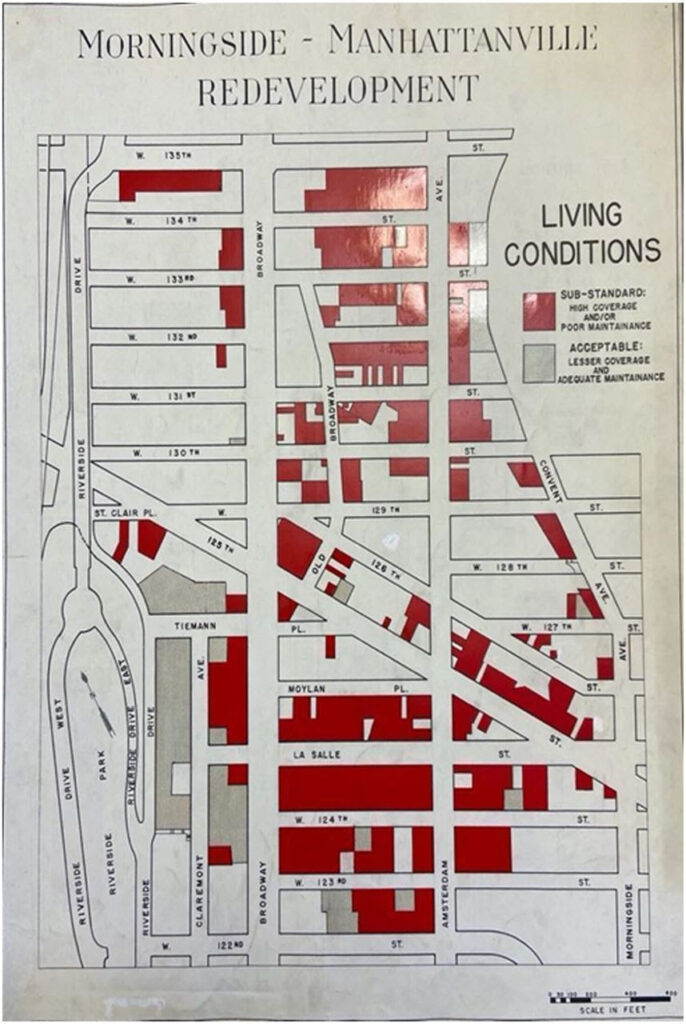
Source: Columbia University Archives. Morningside Area Alliance records, 1947-1992. Box 199, Folder 1.
Hiba Bou Akar and Martine Johannessen examine the spatial history of the Ulysses S. Grant Houses and Columbia University’s planning projects in Manhattan in “The Making of a Split City: Planning, Urban Renewal, and Resistance in the Spatial Production of Morningside Heights, New York City.” In 2020, the Grant Houses recorded one of the highest COVID-19 death rates in public housing in the city. This article focuses on two key moments that help explain its poor fate: mid-century urban renewal and Columbia’s expansion into Manhattanville in the twenty-first century. It examines how Columbia has used planning tools, health discourses, and policing to secure land and displace or contain neighboring Black communities. Drawing on archival materials, the article introduces the concept of the split city to describe a form of racialized urbanism shaped not by complete separation but by selective and conditional inclusion. The split city is not a stable or totalizing formation. It is shaped by ongoing struggle, as residents have continually resisted erasure and asserted their right to the spaces and futures of Morningside Heights.